Hongueras Pjiekakjoo; Wild Mushrooms, Forest, and Memory

Updated: Jun 3
Before a mushroom reaches your plate, there were grandmothers, mothers, and daughters who knew how to find it in the dark, who cut it without pulling out the root, and who shook its spores back onto the soil so it could exist again the following year.
The first rain of June arrives before dawn.
The oyamel fir forest is still dark. A mushroom forager picks up the palm basket and the wooden-handled knife that once belonged to her grandmother. She sharpens it twice against the stone beside the hearth. In this forest, foraging begins when you are still a child. There are girls who already walk slowly among the trees, learning to see what their mothers and grandmothers have taught them to look for.
The place is Lomas de Teocaltzingo, in the municipality of Ocuilan, State of Mexico, within Lagunas de Zempoala National Park, at the heart of the Water Forest shared by the State of Mexico, Morelos, and Mexico City. The communal territory of the Tlahuica-Pjiekakjoo community spans 18,854 hectares, of which nearly 12,000 are covered by oyamel fir, pine, oak, and cloud forest. In this forest, three decades of research have produced the largest ethnomycological record of a single Indigenous community in Mexico, and the second largest in the world.
202 Species, a Living Memory in the Tlahuica-Pjiekakjoo Language
This knowledge has been built through an ongoing chain of dialogue. In the 1990s, researcher Armando Palomino Naranjo documented around 40 species. In 2013, Miriam Aldasoro Maya reached 80. In 2017, Eliseete Ramírez Carbajal documented 160. And in 2025, the cooperative she leads together with the Colegio de Postgraduados reached 202 recognized species.

When the Name of a Wild Mushroom Is Also a Coordinate in the Forest
Each one of those 202 mushrooms has a name in the Tlahuica-Pjiekakjoo language. Nchjo kjøndi, the blue mushroom (Lactarius indigo), whose stem bleeds blue when cut. Nchjo Panzi, the porcini mushroom (Boletus edulis). Nchjo mji, the orange saffron milk cap (Lactarius deliciosus), which only appears under certain conditions of shade and humidity. The prefix Nchjo means mushroom. What follows tells you where it lives, which tree it is associated with, how it tastes, and when it appears.
The scientific name of a mushroom is a morphological description, while its Tlahuica name is a coordinate in the forest. Eliseete remembers something that does not appear in any catalogue, her grandmothers named mushrooms that no longer exist, species that disappeared due to overexploitation and urban expansion into the forest before anyone had the chance to record them. Their names survived for a while in the memory of elder women, without a body to refer to, becoming something that was neither evidence nor falsehood, but rather the form knowledge takes when it loses the object that once sustained it, until those names, too, disappeared.
The Hongueras Pjiekakjoo collective was born in 2015 from a question its founders have been exploring for almost twelve years, how can value be generated through mushrooms while also promoting their dissemination and recognition? For them, both dimensions strengthen one another. Mushrooms are economic sustenance, biocultural heritage, and a vehicle for knowledge, all at once.
Ten women who, since 2024, have formed a formally established cooperative with their own brand, barcode, and partnerships with fair-trade spaces such as Mercado Alternativo de Tlalpan, Tienda UNAM, Casa Espora, Huerto Roma, and Cencalli. Their products transform fresh mushrooms into seasonings, salsa macha, pickled preserves, medicinal teas, and extracts. The season stretches out inside each jar, the months from July to October condensed into something that can be preserved, shared, and travel beyond the forest. They also lead mycotourism walks. In a single season, more than 300 people walk with them through the forest.

Ñeptumendye (Abuela) con hongos. Foto: Hongueras Pjiekakjoo 
Canasta con ñechjo (hongos). Foto: Hongueras Pjiekakjoo 
Hongueras Pjiekakjo. Foto: Hongueras Pjiekakjoo 
Canasta con ñechjo (hongos). Foto: Hongueras Pjiekakjoo
From Forest to Plate, Inequality in Gastronomic Value
When a wild mushroom leaves its territory and reaches the city, when a chef transforms it into a dish, when it appears on a tasting menu, its value multiplies eightfold compared to its sale price in the field. The American matsutake (Tricholoma magnivelare), which grows in the forests of Oaxaca, has been exported to Japan since the 1980s. For more than 35 years, it has generated millions in the Japanese market. The communities who know it, who find it, who understand in which part of the forest it grows after which rain, sell it to intermediaries at regional market prices.
The story that gives value to the ingredient is built in the city. The person with the deepest knowledge of that ingredient is the most invisible in its final consumption. For twelve years, the Hongueras Pjiekakjoo have been trying to solve that equation, seeking to keep knowledge, narrative, and benefit in the same place.
Back in “Las Pastoras”, the area of the northern oyamel fir forest where nchjo nda (fried chicken mushroom / Lyophyllum sp.) fruits best, Eliseete finds the first mushroom before she sees it. First, she smells it.
Then she kneels and cuts it without pulling out the root. She shakes the sporome over the soil to let the spores fall, what she calls seeds, what the mycelium will receive as instructions for the coming year.
This is how knowledge is transmitted in this community, in the forest, by learning through the territory. The body learns before the mind does, and what the body learns was learned from a grandmother who learned it from hers. What few people know about the mushroom they eat is that what appears above the soil is not the organism itself, but its reproductive structure. The real organism is the mycelium, a network of white filaments that can extend across several square meters of forest soil, connecting trees to one another, transferring nutrients between roots, and regulating the health of the entire ecosystem. The most valuable wild edible mushrooms, the ones the Hongueras gather, are ectomycorrhizal, they live in obligatory symbiosis with trees. Without oyamel fir, there is no nchjo letu (morel / Morchella rufobrunnea). Without pine, there is no nchjo nda (fried chicken mushroom / Lyophyllum sp.) Without forest, there is nothing.
The mycelium senses it before anyone else notices. When a tree is cut down, the network associated with it collapses in silence, and that silence is the most urgent part of this story.
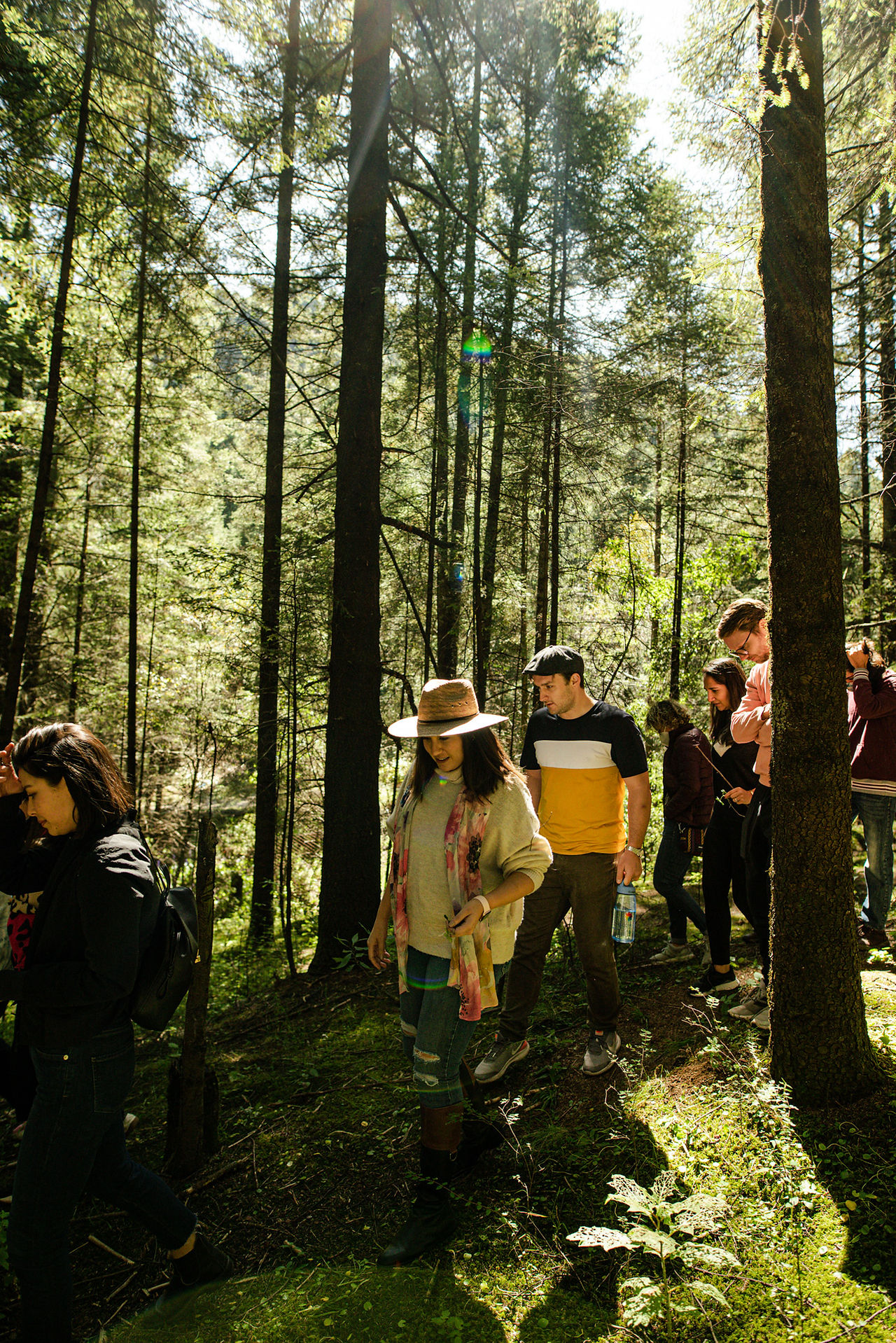
Recolección de hongos. Foto: David Lopez para COMA.MOS Bosque de Oyamel. Foto: Daniel Patlan para COMA.MOS 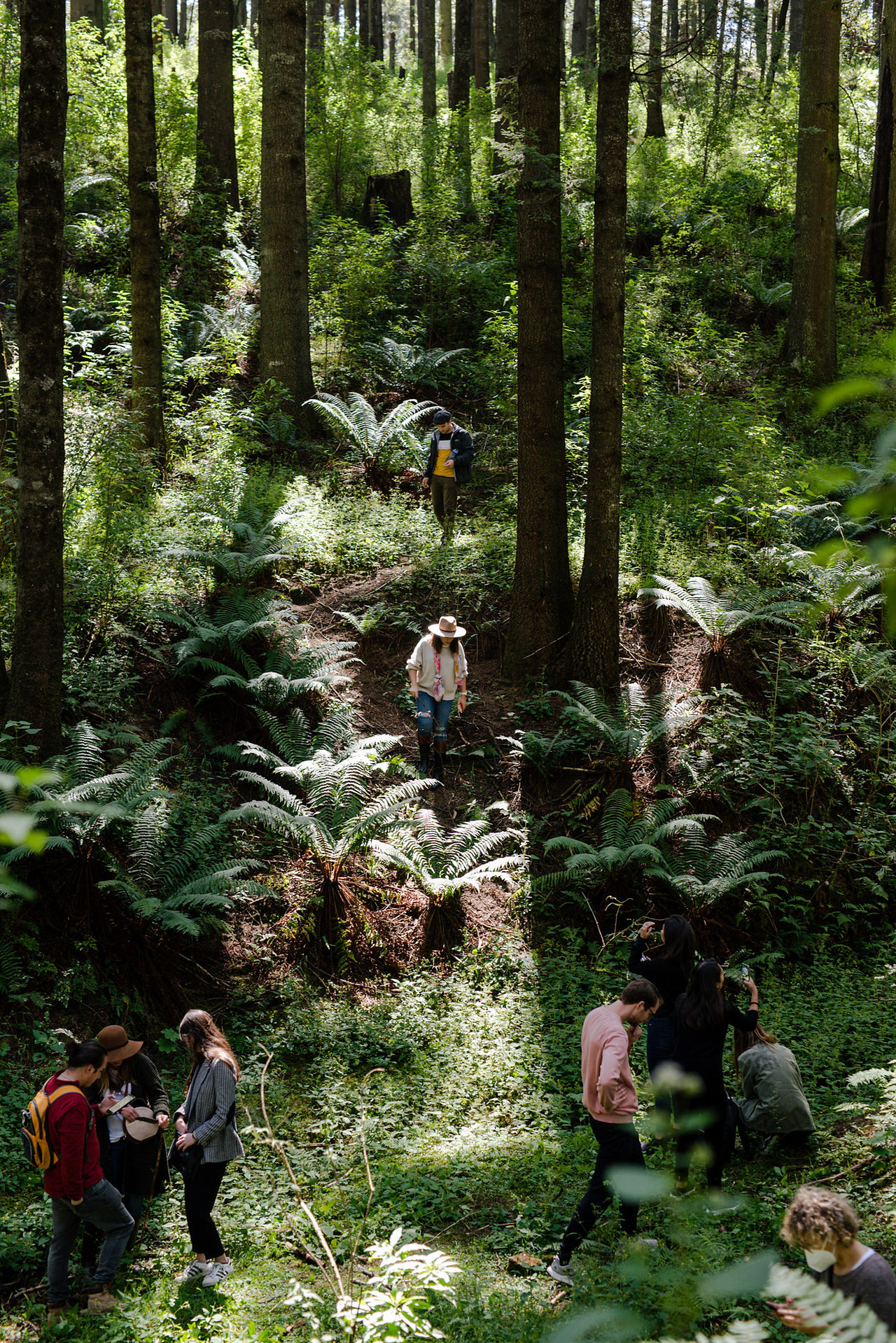
Recolección de hongos. Foto: David Lopez para COMA.MOS Bosque de Oyamel. Foto: Daniel Patlan para COMA.MOS
The forest where the Hongueras work faces pressures that do not appear on any menu. Illegal logging remains active in neighboring municipalities. The Bosque de Agua has lost nearly 40% of its extent over the past thirty years. Climate change is shifting the phenology of wild mushrooms. The four-month season (from July to October) that concentrates all the knowledge, all the economy, and all the cultural transmission of the system can move, shrink, or disappear.
Three generations sustain this knowledge, the grandmothers who named mushrooms that no longer exist, the mothers who learned before they disappeared, and the Hongueras who now gather, translate, and transmit. It is an oral ethic of care that cannot be interrupted without irreversible consequences. Each link that is lost carries with it names, places, preparations, and ecological relationships that no archive can recover.
The loss is not in the future. It is already happening.
By midday, they return. The basket carries nchjo jiyaa, known as campanita or señorita mushroom (Clitocybe gibba), nchjo suli, known as pipilas or mountain mushroom (Agaricus subrutilescens), and nchjo ts’ongue ñutjui, known as gachupín or catrín (Helvella lacunosa). The comal has been heating since before they arrived, because the harvest begins in the forest, but only fully takes shape in the kitchen.
The nchjo kjøndi, or blue mushroom (Lactarius indigo), are washed carefully, dried with a cotton cloth, and torn apart by hand because this mushroom is not cut, it is pulled apart. They go onto the dry comal, with no oil and no water. Just the mushroom, the heat, and time. Then coarse-grain salt is added, and nothing more.
Then the smell fills the kitchen. It also fills that space between what is learned and what is passed on, where knowledge needs time and heat to open. In the community, there is a question that returns every season. It is asked by those who go into the forest and by those who wait for their return. Will there be mushrooms next year? The answer of the Hongueras is always the same. If we care for the forest, yes.

Nchjo jiyaa / Campanitas. Foto. Elías Ahumada 
Plato con mix de hongos. Foto. Elías Ahumada 
Nchjo weto / Trompa de puerco. Foto. Elías Ahumada 
Nchjo mji / Enchilados Foto. Elías Ahumada 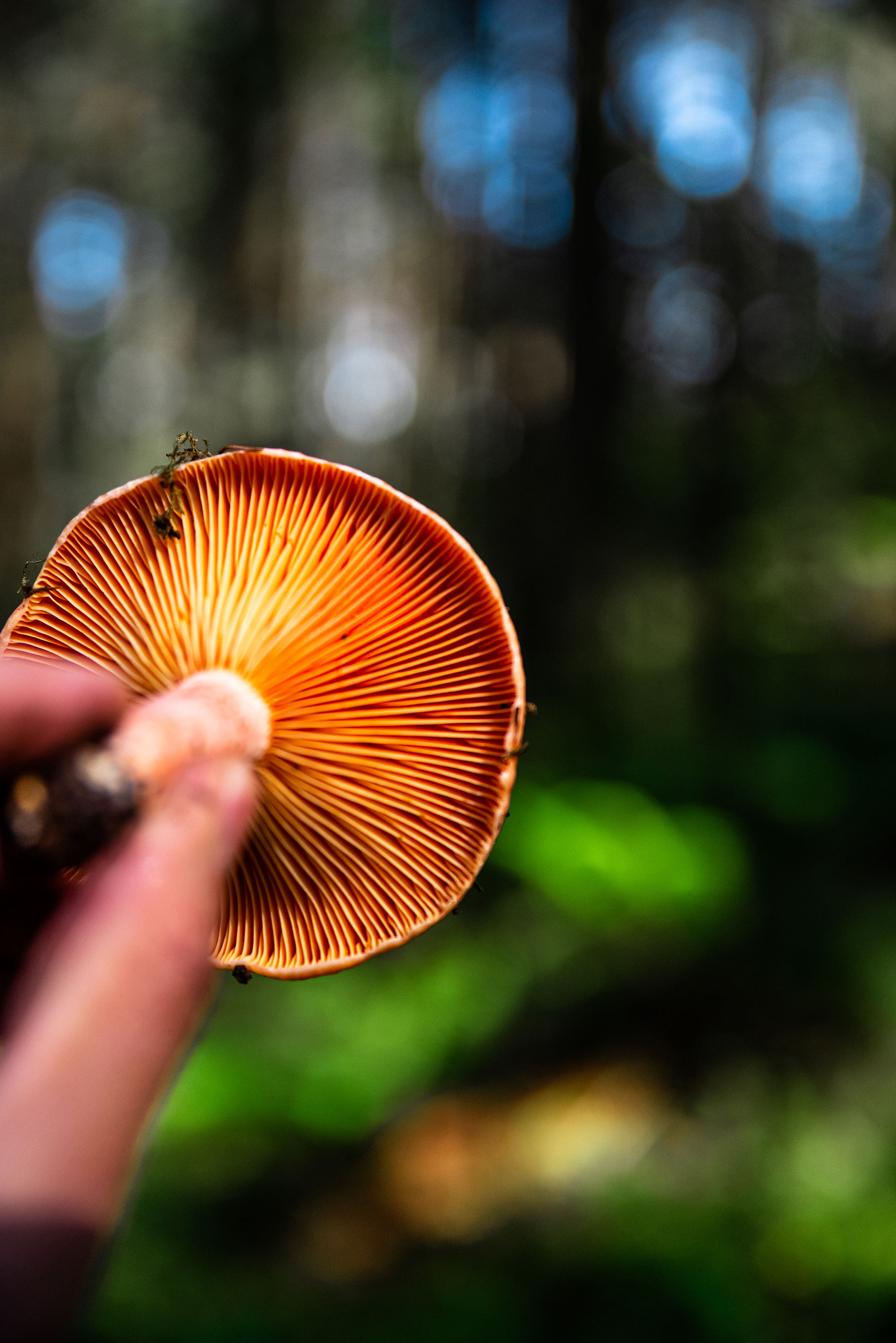
Nchjo mji / Enchilados Foto. Elías Ahumada 
Nchjo jiyaa / Campanitas. Foto. Elías Ahumada
They do not say who has to care for it. They let the question remain in the air, taking the place left behind by the smell of the mushroom. For twelve years, the Hongueras Pjiekakjoo have been building autonomy, knowledge, and a solidarity-based economy from a communal forest of 18,854 hectares. What the Mexican gastronomic system still owes them is this. When that mushroom reaches a plate, the story that accompanies it should also travel from the place where it was born.
May the traceability of the product work like the mycelial network, a silent weave connecting origin, territory, care, and journey, sustaining the living story of everything that reaches us. The next time you eat a wild mushroom, ask where it comes from. Ask its name. The name by which it is recognized in the forest.


Comments